
Intro to Montessori
Montessori Thrive • October 18, 2017

An Introduction to the Montessori Classroom for New Montessori Parents

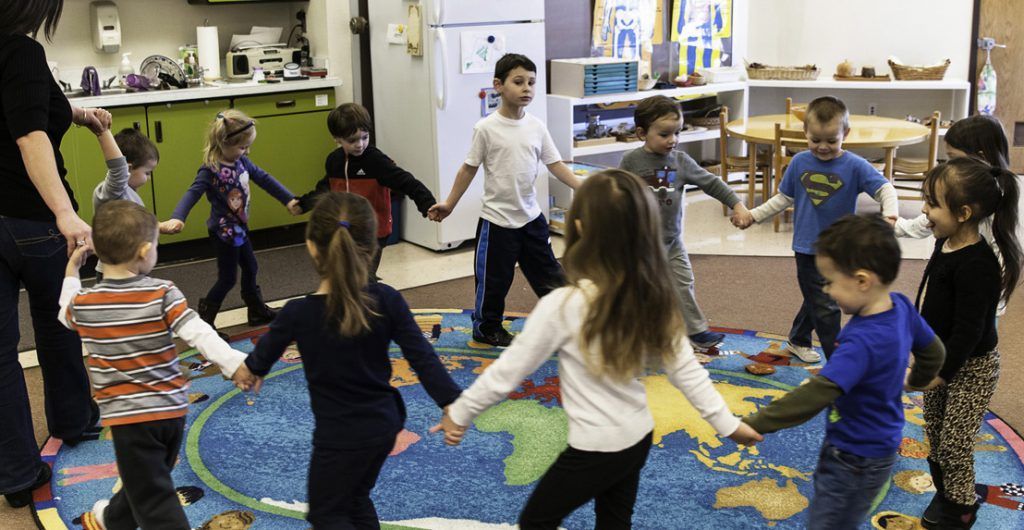
• Circle time – These are daily gatherings of the whole Montessori class and occur at the beginning and end of the day as well as at transition times. Circle may include: calendar, singing, stories, science experiments, group lessons, problem solving.


• Lessons/Activities – This is direct instruction by a teacher. Lessons (also referred to as activities) are usually presented one-on-one or in a small group. After a lesson is presented, your child may work on that activity any time it is available.


• Work – A child’s work refers to a learning activity or set of Montessori materials. It includes direct and indirect aims, control of error, points of interest, and extensions. Work in the preschool classroom mostly consists of one- or two-person activities.


• Mats – All work in the Montessori classroom, except written work, is done on mats. The mat clearly delineates the student’s personal work space. Don’t be surprised if your child comes home asking for a mat to work on!


• Snack – It is not unusual for snack to be a child’s favorite activity! Snack in the Montessori classroom is treated as a work. Your child will have a lesson on snack preparation. Afterward, he will be able to prepare and serve himself a snack during the day. Snack is kept simple and is not meant to replace a healthy meal.


• Quiet or “Inside” voice – Children often need a lesson on finding and using their quiet voice in the classroom. This ensures a respectful working environment for everyone.


• Practical Life – Practical Life activities are the traditional works of the family and home. They allow children to gain independence and self-discipline, develop gross and fine motor skills, build concentration, as well as indirectly prepare for math and writing. Maria Montessori observed that children prefer real work over imaginary work and real, child-sized tools are used.


• Sensorial –Sensorial work covers every quality that can be perceived by the senses. The purpose and aim of Sensorial work is for the child to acquire clear, conscious, information and to be able to then make classifications in the environment. The Sensorial and Practical Life work is unique to the Montessori classroom.


• Grace and Courtesy – Preschool children are in a sensitive period for learning good manners and becoming aware of being part of a community. Common courtesies such as saying please and thank you, greeting visitors, serving food, holding the door open and pushing in chairs are presented as lessons to the children.


• The Peace Table or Peace Place – Dr. Montessori recognized children as the redeeming factor in the evolution of humankind. ThePeace Table (or Place) is a designated place where children can go to peacefully resolve conflict and work out their differences.


Your child’s enthusiasm for their Montessori classroom may become contagious. For further reading on the Montessori preschool environment you may wish to try:


• A Parents’ Guide to the Montessori Classroom, by Aline D. Wolf
• Child of the World: Michael Olaf’s Essential Montessori for Ages 3-12+, by The Michael Olaf Company
• How to Raise an Amazing Child the Montessori Way, by Tim Seldin
• The Montessori Way, by Tim Seldin




July 30, 2026
This is a subtitle for your new post
A woman is using a calculator while a man is writing in a notebook.
By Montessori Thrive September 19, 2022
Adolescents exist between two worlds: they are no longer children but they aren’t yet adults. On this bridge to adulthood, adolescents need opportunities to develop real, meaningful, adult-level skills. They aspire to do what adults do. They are curious about how to make their own way in the adult world. As adults, we are part of an economic system. Even if we aren't using money to buy something, through our work or our hobbies we produce or consume aspects of culture. In this way, economics is about the web of interdependence we have with other people. We all depend upon the work and activity of others.  Economics and Interactions If we look at economics as how people offer value in their interactions, as well as the production, distribution, and consumption of services and goods, we can really think about economics as how we organize ourselves in society. Because adolescents are building the skills for stepping into the adult world, it’s important to consider how they are developing their ability to navigate this economic aspect of adult life. How many of us had the opportunity, as adolescents, to develop the skills necessary for economic independence? How would our lives be different if, as adolescents, we had a support system so we could Oigure out a fair and reasonable cost for goods we produced, faced the reality of a proOit and loss statement, or found our way in navigating the paths of spending, saving, and sharing? Road to Achieving Economic Independence Dr. Maria Montessori realized the importance of adolescents developing these kinds of skills. In From Childhood to Adolescence, Dr. Montessori made a bold statement about our approach to education and its impact on the greater society. She stated it clearly: “The essential reform is this: to put the adolescent on the road to achieving economic independence.” So in Montessori adolescent programs, we offer our emerging young adults the opportunity to learn key skills of production and exchange. We sometimes call this “microeconomy.” The basic idea is that adolescents need opportunities to produce goods and services, and work with money and monetary systems, so they can develop an understanding and appreciation for how economies work and their own role in economic systems. Real, Meaningful, and Purposeful Work This experience can take many different forms depending upon the community. Whether running a farm stand or a holiday marketplace, adolescents get to learn key skills. They learn to balance proOit and loss. They discuss and determine how much money should be reinvested into the business to help it grow or how much money should be reinvested in the greater community. They respectfully listen to their customers’ needs and concerns and incorporate that feedback in useful ways. In order to have these learning experiences, adolescents need real, meaningful, and purposeful work. Just like young children need to actually prepare food rather than play with a pretend kitchen set, adolescents need actual experiences in creating a business plan, keeping track of income on a spreadsheet, and balancing a budget. They need to practice accounting work so they can build the skills for their own economic independence. They need to have the thrill of handfuls of cash and then face the responsibility of keeping track of those earnings. They need the experience of paying for replacement materials when they have overused key supplies. If they have developed some savings and want to invest the money, they need to Oind opportunities that align with their values. Preparing for Adult Life Too many of our young people enter the world of adult lives without having experienced their role in an economy (perhaps other than being consumers!). Economic independence is a key part of preparing for adult life. We want our adolescents to step into maturity with conOidence that they can independently navigate their new responsibilities and roles. If we give adolescents the opportunity to learn how to have a sound basis for their economic decisions, imagine where they will be when they are adults and making decisions that affect broader aspects of society!